Key Takeaways
-
01
Bouncie is the best overall GPS tracker for most teenage drivers, thanks to crash detection.
-
02
MOTOsafety wins for coaching a brand-new driver with its daily driver's report card.
-
03
SpaceHawk is the best hidden option for teens who might try to unplug an OBD tracker.
-
04
Konnect GPS matches the fastest 3-second real-time updates at the lowest monthly cost.
-
05
Vyncs replaces monthly subscription billing with an annual renewal for long-term savings.
As an Amazon Associate, SpaceHawk GPS earns from qualifying purchases.
Best GPS Trackers for Teenage & New Drivers (2026)
Handing your teen the keys is exciting, but it's also one of the biggest parenting milestones filled with uncertainty. The best GPS tracker for teenage drivers gives you real-time location, driving alerts, and a little more confidence every time they pull out of the driveway. Every parent hopes their teen arrives safely, but accidents, speeding, and distracted driving are real concerns for new drivers.
The right GPS tracker helps you to spot risky habits early, respond faster in an emergency, and have better conversations about safe driving.
I'm Ryan Horban. For 15+ years I've installed and tested GPS trackers on everything from work fleets to family cars, and for this guide I ran these five on a real new driver's car, watching which alerts fired and how fast. Below you'll get five honest picks, what each one does best, and the features that actually help a new driver.
Let's find the one that fits your family.

The Tracker Your Teen Can't Unplug
Real-Time GPS Tracking for Your New Driver
3-second live updates, hidden magnetic or hardwired install, geofence + speed alerts, and no OBD port sitting in plain view. The tracker built for parents who need real answers, not workarounds.
What Is the Best GPS Tracker for Teenage Drivers?
Bouncie is the best GPS tracker for most teenage drivers because it combines crash detection, real-time GPS tracking, speed alerts, and excellent value. If you want the lowest-cost real-time GPS tracking, Konnect GPS is the top budget pick, while Vyncs is ideal for parents looking to avoid traditional monthly subscription fees.
If your priority is coaching a new driver, choose MOTOsafety. For discreet tracking, SpaceHawk is the best hidden option.
| Spec | Bouncie | MOTOsafety | SpaceHawkOur brand | Konnect GPSSister brand | Vyncs |
|---|---|---|---|---|---|
| Product |  |
 |
 |
 |
 |
| Best For | Overall teen safety | Report card coaching | Hidden real-time | Budget real-time | No monthly fee |
| Type | OBD plug-in | OBD plug-in | Magnetic or hardwired | OBD plug-in | OBD plug-in |
| Real-Time Updates | 15 sec | 60 sec | 3 sec | 3 sec | 60 sec (Basic) |
| Key Safety Feature | Crash detection | Daily driver's report card | Hidden tamper-resistant install | Fast real-time tracking + geofence alerts | Trip and driving behavior data |
| Subscription | $9.65/mo | $19.95/mo | From $9.95/mo | $8.95/mo | No monthly fee (from $99.99/yr) |
| Buy | Buy on Amazon | Buy on Amazon | Buy on WebsiteBuy on Amazon | Buy on Amazon | Buy on Amazon |
Prices reflect U.S. listings at the time of publication and may change during promotions or sales. Use them as a general guide. Before you choose a GPS tracker for your teen driver, it's worth understanding which features actually make the biggest difference for safety and driving habits.
Our Own Tracker Placed Third. We Left It There.
SpaceHawk is our product. We build it, we sell it, and it finished third on this list. Bouncie's crash detection and MOTOsafety's daily report card do more for a brand-new driver than SpaceHawk does, so both placed above it. Konnect, a sister brand under the same ownership, sits below it at fourth.
SpaceHawk wins exactly one category here, and it's a narrow one: staying put when a teen goes looking for the tracker. That's a real problem for some families and no problem at all for others. If your teen has never touched the OBD port, buy the Bouncie.
We could have written this list the other way around. But the subject is a teenager behind the wheel, and a ranking bent toward our own hardware would make this guide worth less to you, not more. Every product below links out to where you can buy it, including the two that beat us.
How I Tested These Teen Driver GPS Trackers
Every GPS tracker in this guide went into a real new driver's car. I rode along on school commutes, weekend errands, and everyday drives, intentionally triggered a few alerts, and timed how quickly each notification reached my phone. Then I used every app the way a concerned parent would late at night, opening it to answer one simple question, "Where's my teen, and are they driving safely?"

I focused on four key factors when ranking these GPS trackers:
- Alert speed and reliability, because a speeding alert that arrives an hour later doesn't help anyone.
- Driving behavior data, including whether the app turned speeding, hard braking, and rapid acceleration into insights you could actually use to coach a new driver.
- Installation and tamper resistance, since an obvious tracker is easy for a curious teen to unplug or disable.
- The true monthly cost, including both the subscription and the hardware price, so you know what you'll really pay over time.

Three of the trackers from this guide during testing. Every unit here went into the same car, on the same routes, so the alert timings below are directly comparable.
I judged these for one job, keeping a new driver safer. The trackers below earned their rankings based on how well they supported safer driving, better awareness, and more confident parenting.
1. Bouncie: Best GPS Tracker for Teenage Drivers Overall
Bouncie is the best GPS tracker for teenage drivers because it goes straight at the biggest teen risk, crashes and speed, and does it for the lowest monthly plan here.
The device plugs into your car's OBD-II port in about ten seconds, then updates location every 15 seconds while sending alerts for speeding, hard braking, and geofence crossings. Crash detection is the feature that earns Bouncie the top spot. Bouncie's built-in accelerometer picks up a real impact and fires a push notification to every linked parent right away, without false-alarming on potholes and speed bumps.
For a new driver, that head start on an emergency response is worth more than any other spec on the box.
Key Features of Bouncie GPS
- Plugs into the car's OBD-II port with real-time location updates every 15 seconds for accurate tracking.
- Crash detection instantly alerts linked parents after a real impact using the built-in accelerometer for added safety.
- Sends speed alerts whenever your teen exceeds a preset speed limit, helping encourage safer driving habits.
- Monitors hard braking, rapid acceleration, and overall driving behavior to identify risky driving patterns early.
- Delivers geofence alerts when the vehicle enters or leaves school, home, or custom virtual boundaries.
- Tracks trip history, engine diagnostics, and maintenance alerts through one user-friendly mobile app for parents.
Pros & Cons of Bouncie GPS Tracker
- Crash detection focuses on one of the biggest safety concerns for teen drivers.
- One of the lowest monthly subscription plans in this guide at $9.65 with no contract.
- Fast 15-second real-time tracking keeps the live map accurate.
- Monitors engine health alongside GPS tracking, which is uncommon at this price.
- User-friendly app that's easy to navigate, even during stressful moments.
- The device remains visible in the OBD-II port, so a teen could unplug it.
- At around $89.99, it has the highest upfront hardware cost in this guide.
I plugged Bouncie into the test car first, and the setup honestly took longer to download the app than to install the device. On a highway on-ramp where my young driver got a little enthusiastic, the speed alert hit my phone before the merge finished.
Later I tapped a curb harder than I meant to during a parking test, and the app logged the jolt without screaming "crash," which told me the sensitivity is tuned by someone who has actually driven a car. The report of the week, hard braking count and top speed, made for a calm Sunday conversation instead of a lecture. For most parents, this is the one I'd start with.
Choose Bouncie if you want the strongest all-around safety solution for a new driver, combining crash detection, real-time GPS tracking, and one of the best values in this guide.
2. MOTOsafety: Best Driver's Report Card & Coaching for New Drivers

MOTOsafety is the best tracker for actually coaching a new driver, because its daily driver's report card turns a week of driving into a simple score you can talk through. The OBD-II device is included free with the plan, runs $19.95 a month, updates location roughly every 60 seconds, and grades speed, braking, and acceleration into something a teen understands. Coaching is where this one pulls ahead.
Bouncie tells you what happened, but MOTOsafety packages it into a report card and a parent portal built around teaching, with curfew alerts and boundary notifications layered on top. For a brand-new driver in their first six months, that structure is gold.
Key Features of MOTOsafety
- Generates a daily driver's report card with scores for speeding, braking, and rapid acceleration events.
- Sends curfew alerts whenever the vehicle moves outside your family's agreed driving schedule.
- Delivers geofence alerts when the vehicle enters or leaves school, home, or custom driving zones.
- Organizes driving history and reports through a parent dashboard built for coaching new drivers.
- Includes the OBD-II tracking device free with every subscription, reducing upfront hardware costs significantly.
- Tracks driving behavior and trip history to encourage safer habits through consistent feedback and coaching.
Pros & Cons of MOTOsafety
- Driver's report card makes coaching conversations clear, practical, and based on real driving data.
- Free OBD-II device keeps upfront costs lower than many competing GPS trackers.
- Curfew and geofence alerts fit naturally into a new driver's daily routine.
- The parent dashboard focuses on coaching instead of simply displaying location updates.
- At $19.95 monthly, one of the more expensive subscriptions in this guide.
- 60-second updates feel slower than trackers offering true real-time GPS tracking.
- Prioritizes coaching over advanced safety features like dedicated crash detection.
I installed MOTOsafety in the same test car the following week, and the driver's report card completely changed the conversation at home. Instead of guessing whether my teen's driving was improving, we reviewed the same score, the same hard-braking events, and the same trip history together.
My teen even insisted one of those braking alerts happened because of a deer, and honestly, they had a point. While the 60-second updates weren't as quick as Bouncie during a live drive, that rarely mattered for coaching. What you're really paying for is a system that helps parents build safer driving habits with real data instead of assumptions.
I'd recommend MOTOsafety if your biggest priority is coaching and building good habits in a brand-new driver and you want the data laid out as a coachable report card.
3. SpaceHawk GPS: Best Hidden, Tamper-Resistant Real-Time GPS Tracker

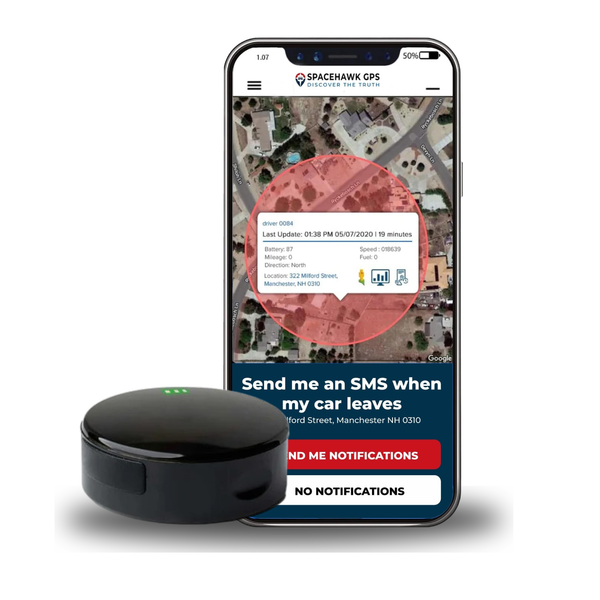
SpaceHawk is the best pick when you want tracking your teen cannot find and unplug, because it hides where an OBD device cannot. Instead of sitting in the dashboard port, SpaceHawk mounts with a magnet out of sight or wires into the car's power, and it reports real-time location every 3 seconds, tying Konnect for the fastest refresh in this guide.
Tamper resistance is the honest reason it lands here. Every OBD tracker above sits in plain view under the dash, and a motivated teen can pop it out in five seconds. A hidden SpaceHawk keeps reporting regardless, which some parents genuinely need. Fair trade-off, it skips the driving report card and crash detection those OBD units specialize in.

The SpaceHawk unit in hand. There is no port to plug into, which is the whole point: where it goes is up to you, not to where the carmaker put the diagnostic socket.
Key Features of SpaceHawk GPS
- Provides real-time location updates every 3 seconds for fast, accurate GPS tracking and monitoring.
- Offers magnetic or hardwired installation for discreet, tamper-resistant vehicle tracking.
- Includes a battery-powered option for flexible placement without using the vehicle's power source.
- Sends speed alerts whenever your teen exceeds a preset speed limit during daily driving.
- Delivers geofence alerts when the vehicle enters or leaves custom safety zones you create.
- Provides accurate GPS tracking with weather-resistant construction for dependable everyday vehicle monitoring.
Pros & Cons of SpaceHawk GPS
- Hidden installation makes it difficult for teens to locate, unplug, or disable the tracking device.
- Fast 3-second updates match the quickest real-time GPS tracking in this guide.
- Battery-powered and hardwired installation options offer flexible placement for different vehicles.
- Speed and geofence alerts help parents monitor everyday driving without constant phone calls.
- Rugged, weather-resistant design supports dependable tracking in nearly any driving condition.
- Doesn't include a driver's report card or coaching tools for improving driving habits.
- No dedicated crash detection or automatic emergency response like Bouncie.
- Requires a monthly subscription starting at $9.95, unlike no-monthly-fee options such as Vyncs.
I hid a SpaceHawk under the seat of the test car and, as a challenge, told my teen driver a tracker was somewhere in the vehicle. Three days later it was still reporting, undiscovered, while an OBD unit I left in the port got noticed and questioned within a day.
The 3-second updates made the live map feel like watching the car move in real time, not catching up to it. What you give up is the coaching layer, since SpaceHawk shows you where and how fast, not a graded report of every stop. For a parent whose real concern is a teen disabling the tracker, that trade is easy.
Choose SpaceHawk if you want a real-time location your teen cannot quietly unplug, or you'd rather keep the OBD port empty.
Tucking a SpaceHawk into a car's side panel. This is the difference between SpaceHawk and every OBD tracker in this guide: an OBD unit has to live in the diagnostic port under the dash, in the one spot a curious teen already knows to check. SpaceHawk goes wherever you can reach, which is why it takes the covert category even though it placed third overall.
4. Konnect GPS: Best Budget Real-Time OBD Tracker
Konnect GPS is the best budget pick for real-time tracking, because it delivers 3-second updates on the cheapest plan in this guide at $8.95 a month. The OBD-II device plugs in under a minute, pulls constant power from the car, and pinpoints location within about 6 feet across 155 countries.
Value is the whole story here. Konnect matches SpaceHawk on update speed and undercuts every plan on price, which makes it an easy on-ramp for parents who want fast, reliable location without a big commitment. Like the other OBD units, it lives in the port where a teen can see it.

The Konnect OBD2 tracker as it arrives in the box.

Plugged into the OBD-II port under the dash. Install really is this quick, and this is also exactly where a teen would look for it.
Key Features of Konnect GPS
- Plugs into the car's OBD-II port with real-time location updates every 3 seconds for accurate tracking.
- Provides GPS accuracy within approximately 6 feet for dependable live vehicle location during daily driving.
- Costs just $8.95 monthly with no contract, making it the most affordable subscription in this guide.
- Sends speed alerts and geofence notifications whenever your teen exceeds limits or leaves designated zones.
- Covers 155 countries with dependable GPS tracking for local driving, road trips, and family travel.
- Includes a lifetime warranty for added peace of mind and long-term ownership confidence.
Pros & Cons of Konnect GPS
- Lowest monthly subscription while matching the fastest real-time GPS updates in this comparison.
- Quick plug-and-play OBD-II installation takes less than a minute to complete.
- Lifetime warranty adds long-term value rarely offered by budget GPS trackers.
- Accurate location tracking keeps the live map dependable throughout everyday driving.
- Visible OBD-II installation allows determined teens to unplug the tracker without much effort.
- Doesn't include a driver's report card or coaching features for improving driving habits.
I moved Konnect into the test car after Bouncie, and the two felt neck and neck on the live map, with Konnect's 3-second refresh noticeably quicker than Bouncie's 15-second cadence. Setup was the usual OBD routine, scan a code, plug it in, done before the coffee cooled. What you don't get is the behavior report card, so this is a location-and-alerts tool rather than a coaching platform. For a parent who mostly wants to know where the car is right now, on the tightest budget, Konnect is hard to beat.
I'd recommend Konnect GPS if you want fast, real-time GPS tracking at the lowest monthly cost without sacrificing reliability.

Another look at the Konnect unit from the same round of testing.
5. Vyncs: Best No-Monthly-Fee Option for Parents
Vyncs is the best choice for parents who refuse to pay a monthly bill, because it runs on an annual plan instead. Vyncs Basic 4G+ runs $99.99 for the first year, which covers the device, the SIM card, and a year of service, plus a one-time $39.99 activation fee. After that you renew at about $99.99 a year rather than paying every month. You still get trip history, driving alerts, geofencing, fuel economy, and engine fault codes.
Long-term cost is where Vyncs makes sense. Add up two or three years of a monthly plan and the annual model can come out ahead, especially for a family watching the budget. The trade is speed, since the Basic plan reports about every 60 seconds rather than in near real time, though the Pro tier samples faster.

The Vyncs unit in hand before install.

A closer look at the same Vyncs tracker during testing.
Key Features of Vyncs GPS
- Runs on an annual subscription instead of monthly billing, helping reduce long-term GPS tracking costs.
- Plugs into the car's OBD-II port for continuous power without requiring battery charging or maintenance.
- Tracks trip history and driving alerts to help parents identify risky driving habits over time.
- Sends geofence alerts whenever the vehicle enters or leaves customized locations like home or school.
- Monitors fuel economy, engine diagnostics, and maintenance data alongside accurate vehicle location tracking.
- Includes 4G LTE connectivity, with 60-second location updates on the Basic plan and faster sampling on Pro.
Pros & Cons of Vyncs GPS
- Annual subscription helps reduce long-term ownership costs compared with most monthly GPS tracking plans.
- Provides detailed trip history and driving data for coaching new and inexperienced drivers.
- Monitors fuel economy, engine health, and vehicle diagnostics alongside GPS tracking.
- Straightforward setup with reliable US-developed software and nationwide 4G LTE coverage.
- Standard location updates are slower than premium real-time GPS trackers in this comparison.
- A one-time $39.99 activation fee raises what you pay in the first year.
- Annual subscription offers less flexibility than month-to-month GPS tracking plans.
I installed Vyncs last, and the no-monthly-fee pitch is the real draw for a parent doing the multi-year math on a teen's car. The trip history and driving alerts gave me enough behavior insight to spot a pattern, though the standard update rate meant the live view lagged the 3-second picks noticeably. For a family that plans to track through the whole learner-to-licensed stretch and hates recurring bills, the yearly model is a smart way to go. Just know you're trading some real-time snappiness for the savings.
Go with Vyncs if you want to skip monthly fees and you value long-term savings and trip data over second-by-second live tracking.
GPS Tracker vs. Phone App: Which Is Better for a Teen Driver?
A dedicated GPS tracker is the better choice for most teen drivers because it provides more reliable tracking, driving alerts, and safety features than a phone app. While free apps like Life360 or your phone's built-in family location sharing are a good starting point, they depend on your teen keeping their phone charged, with location sharing enabled, and bringing it on every trip.

A dedicated GPS tracker stays with the vehicle, not the phone. Even if your teen turns off location sharing, leaves their phone behind, or the battery dies, a hardwired, hidden, or OBD-II tracker continues reporting the vehicle's location.
The honest trade-off between your two main options looks like this.
- Free phone apps cost nothing but depend on your teen keeping location sharing enabled.
- GPS trackers provide real-time tracking, driving behavior data, and alerts, although they remain visible.
My advice is simple. Start with a free phone app if your budget is limited and trust isn't a concern. The moment you want reliable location tracking, driving data, or alerts your teen can't simply switch off, move to a dedicated GPS tracker.
In my experience, most families with a brand-new driver reach that point much sooner than they expect.
How to Choose the Best GPS Tracker for Your Teen (Buying Guide)
The best GPS tracker for your teen depends on what matters most to your family. If you want to coach safer driving habits, choose a tracker with driving reports and behavior monitoring. If your priority is real-time location, look for fast GPS updates and reliable alerts. Your budget, preferred installation method, and subscription costs should also influence your decision.

Picking the right tracker comes down to four simple questions about your teen, your budget, and how you plan to use GPS tracking. Answer them in order, and the best choice usually becomes clear.
Do You Want Driving Data or Just Location?
If your goal is building safer driving habits, choose a tracker with driver's report cards, speed alerts, and driving behavior monitoring, like MOTOsafety or Bouncie. If you mainly want to know where the vehicle is right now, SpaceHawk and Konnect GPS offer faster real-time location tracking. Match the tracker to your biggest concern, coaching or live location.
OBD-II Plug-In or Hidden Installation?
Your choice comes down to one simple question. Do you want the easiest installation or the most discreet tracking? Both options keep tabs on your teen's vehicle, but they serve different needs.
- OBD-II trackers install in minutes, receive constant power, and provide engine diagnostics and driving data.
- Hidden trackers are harder to find or remove, making them better for discreet vehicle monitoring.
If your teen knows about the tracker, an OBD-II model usually makes the most sense. If keeping it concealed is important, choose a hidden tracker.
What Do the Subscription Costs Really Add Up To?
Subscription costs range from about $9 to $20 per month, so long-term pricing matters. Konnect GPS has the lowest monthly plan, Bouncie offers excellent value with crash detection, MOTOsafety charges more for coaching tools, and Vyncs replaces monthly billing with an annual subscription. Before buying, check whether your auto insurer offers discounts for monitored driving or telematics programs.
Should You Tell Your Teen They're Being Tracked?
In most cases, yes. Being open about GPS tracking builds trust while encouraging safer driving habits.
Many parents find that simply knowing the vehicle records speeding, hard braking, and location encourages teens to make better decisions behind the wheel. Hidden tracking can make sense when there's a legitimate safety concern or a risk the tracker will be removed, but those situations should be the exception rather than the rule.
If you're unsure about the legal requirements where you live, read my guide explaining whether is it illegal to put a GPS tracker on someone's car before installing any tracking device.
What Features Should You Look For in a Teen Driver Tracker?
The most important features in a teen driver GPS tracker are speed alerts, geofence alerts, a driver's report card, crash detection, and real-time location tracking. These tools help parents identify risky driving habits, respond quickly to emergencies, and coach safer driving over time.

I've seen parents choose a tracker based only on price, only to realize it does little more than show a dot on a map. That's not enough. The goal isn't to spy on your teen. The point is to spot risky behavior early and use real driving data to build safer habits.
Here are the features that matter most.
Speed Alerts
Notify you immediately when your teen exceeds a preset speed limit.
Geofence and Curfew Alerts
Monitor arrivals, departures, and driving outside agreed schedules.
Driver's Report Cards
Track hard braking, rapid acceleration, and other risky driving behaviors.
Crash Detection
Sends immediate notifications after a serious impact for faster emergency response.
Real-Time GPS Tracking
Shows your teen's current location whenever you need to check.
Every tracker in this guide focuses on a different combination of these features. Choose the one that best matches your family's biggest safety concern.
Before you install: whose car is it?
Fitting a tracker to a car you own and insure, driven by your own minor child, is the clearest and most defensible case there is, and telling your teen about it is the approach we recommend throughout this guide.
The rules change the moment the vehicle isn't yours. Placing a tracker on a car titled to someone else, including an adult child, a roommate, a partner, or an ex, without their agreement can carry criminal exposure and civil liability, and several states treat tracking a person without consent as stalking or unlawful surveillance. If the car is in your teen's name, or your teen has turned 18, get their agreement first.
This is general information rather than legal advice, and the rules vary by state. Read our full guide to GPS tracking laws before you install anything.
About this guide
SpaceHawk GPS sells one product: the SpaceHawk tracker, which is our own device and the #3 pick on this list. Konnect GPS, at #4, is a sister brand under the same ownership, sold through its own storefront rather than here.
Bouncie, MOTOsafety and Vyncs are other companies' products. We link to them through Amazon affiliate links that earn us a commission at no extra cost to you. That commission does not move anything up or down the list, which is why the two picks above our own device are the ones we recommend to most families.
Conclusion: Which Teen Driver GPS Tracker Should You Buy?
The best GPS tracker for your teen ultimately depends on what gives you the greatest peace of mind.
If you want the best all-around balance of real-time tracking, crash detection, driving alerts, and value, Bouncie is my top recommendation for most families. If your focus is coaching a brand-new driver, MOTOsafety stands out with its driver's report card. SpaceHawk is the best choice for discreet tracking that a teen can't easily disable, Konnect GPS delivers excellent real-time tracking at the lowest monthly cost, and Vyncs offers the best long-term value for parents who want to avoid monthly subscription fees.
No GPS tracker can replace good parenting or responsible driving habits, but the right one can make those conversations easier. Instead of relying on assumptions, you'll have real driving data, location updates, and safety alerts that help you guide your teen with confidence.
For me, that's the biggest benefit of every tracker in this guide. They don't just show where your teen is.
They help you build safer driving habits, respond faster when something goes wrong, and give both you and your new driver a little more confidence every time the keys leave the driveway.
 |
|
||||||||
 Buy on Amazon