


Key Takeaways
-
01
Ownership and consent decide everything — tracking a vehicle or asset you own is legal in all 50 states, and so is tracking with the other person's agreement.
-
02
Tracking a person without consent is a crime in many states, either under a dedicated tracking statute or under stalking and surveillance law.
-
03
Employers can track company-owned vehicles anywhere in the U.S. — the variable is whether your state requires advance written notice to the employee.
-
04
New York, Connecticut, and Delaware have the most prescriptive employee-monitoring rules, each requiring advance written notice by statute.
-
05
The Fourth Amendment restrains police, not private citizens — your exposure as a civilian comes from state stalking, surveillance, and privacy law instead.
As an Amazon Associate, SpaceHawk GPS earns from qualifying purchases.
Is GPS Tracking Legal in the U.S.? Here's the Truth, State by State
Never place a tracker on a person without their consent
Everything on this page assumes you are tracking property you own. Putting a GPS tracker on another adult's vehicle, bag, or belongings without their agreement is a criminal offense in many states — prosecuted under a dedicated tracking statute in California, Texas, Florida and Virginia, and under stalking or surveillance law almost everywhere else. Penalties run from misdemeanor charges and fines to felony exposure where the tracking is repeated or causes fear, plus civil liability for invasion of privacy.
Tracking a spouse, partner, or ex without their agreement is not a grey area, and shared finances or a shared address do not create permission. If you are being tracked by someone else and feel unsafe, help is available:
- National Domestic Violence Hotline — 1-800-799-7233, or thehotline.org for 24/7 chat
- SPARC (Stalking Prevention, Awareness & Resource Center) — stalkingawareness.org
- If you find a device you did not place, photograph it where it sits and contact local law enforcement before removing it.

Can you legally track someone's car, phone, or movements, and what do U.S. GPS tracking laws actually say? In a world of hidden GPS trackers and phone-based location sharing, this looks like a tech question. It is really a legal one, and it affects you.
Consider three real-life scenarios:
- A parent tracks their teenager's car to make sure they get home safe.
- An employer monitors delivery drivers during work hours.
- A spouse secretly hides a GPS tracker in their partner's vehicle.
One of these is clearly legal. One walks a fine legal line. One could land you in court.
Whether you're protecting your child, managing a fleet, or worried that someone is tracking you, these rules matter. This guide explains when GPS tracking is legal, when it becomes a crime, how the rules change from state to state, and how to stay compliant under U.S. law.
The short answer
- Your own property: legal everywhere. You do not need anyone's permission to track a car, trailer, or device you own.
- Your minor child: legal for parents and legal guardians in every state.
- Company vehicles: legal in all 50 states. Several states require advance written notice to the employee first.
- Someone else's vehicle or person: illegal without consent in most states, and prosecutable as stalking.
- Police: need a warrant in practice to attach a tracker or pull historical location records.

"I've reviewed dozens of state laws over the years, and nearly all treat covert GPS tracking as a serious privacy violation, especially when done without consent or disclosure."
Ryan Horban
GPS Tracking Expert
What Is GPS Tracking?
GPS tracking means using a device or app to monitor the location of a person, car, or object, either in real time or over a period of time.
Most GPS trackers use satellites, cellular networks, and apps to send location data you can view on your phone or computer.
There are two main types:
- Real-time tracking: shows live location updates, like watching a moving dot on a map.
- Passive tracking: records location data that can be reviewed later.
Setting up a tracker? Our step-by-step hardwired GPS installation guide covers doing it safely and legally.
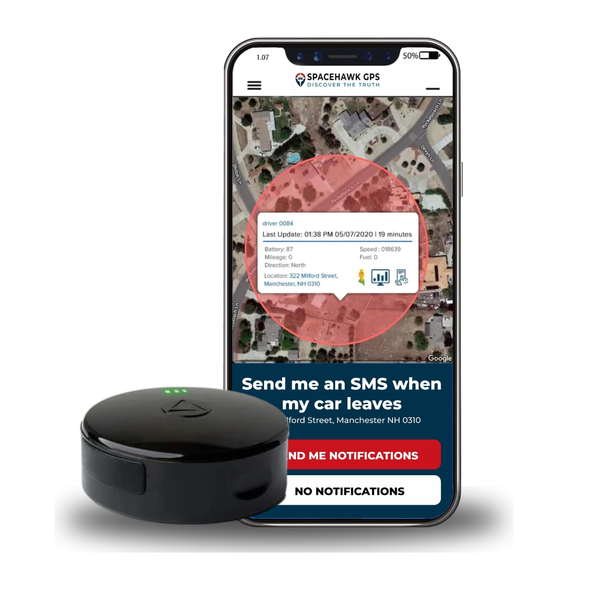
SpaceHawk GPS Tracker
Built for the use case this whole guide says is clearly lawful: tracking a vehicle, trailer, or asset you own. Magnetic mount, no install, and location history you can hand to police if the vehicle is ever taken.
- 3-second updates
- ~6 ft accuracy
- IP67 waterproof
- Magnet or hardwire
- 1 year of history
- Lifetime warranty
Is GPS Tracking Legal in the USA?
GPS tracking is legal in many situations, but only when it follows federal law and respects personal privacy. Three questions decide almost every case.
1Ownership
Do you own the car, phone, or asset being tracked? Ownership is the single strongest position in U.S. tracking law.
2Consent
Does the person know about the tracking and agree to it? Written consent beats verbal, and verbal beats nothing at all.
3State law
Are you following your state's rules as well as federal ones? A dozen states have dedicated tracking statutes; the rest use stalking and surveillance law.
Reminder: GPS tracking is legal when you own the asset or have clear approval. Courts care about consent, not intentions.
Key Federal Laws and Rulings That Shape GPS Use
A handful of federal statutes and Supreme Court decisions set the outer limits on GPS tracking in the United States — mostly by restricting what the government can do. Here is what each one actually held.
1United States v. Jones (2012)
The Supreme Court held that attaching a GPS device to a vehicle and using it to monitor movements is a Fourth Amendment search, on the reasoning that the government physically trespassed on private property to gather information.
What it did not do is settle whether that search always requires a warrant — the Court expressly left the question open. Police in Jones had obtained a warrant; they simply executed it improperly, installing the device on day 11 of a 10-day authorization and in the wrong jurisdiction. Read the opinion on Justia.
2Carpenter v. United States (2018)
Police need a warrant to obtain historical cell-site location records from a wireless carrier. Note the subject: this case is about phone company records, not about GPS trackers, so it is often cited too broadly. Case summary on Cornell Law.
3Electronic Communications Privacy Act
Passed in 1986, the ECPA protects digital data in transit and in storage — phone records, texts, and emails among them. It sets limits on interception by both government and private parties. ECPA overview from the U.S. Department of Justice.
4The Fourth Amendment
The Constitution protects people against unreasonable searches and seizures by the government. That last part matters more than most guides admit. Read the Fourth Amendment.
The distinction most articles get wrong: the Fourth Amendment restrains police and other government actors. It does not apply to private citizens. If a neighbor puts a tracker on your car, they have not violated your Fourth Amendment rights — they have likely violated a state stalking or surveillance statute, and exposed themselves to a civil invasion-of-privacy claim. Both routes carry real consequences; they are just different bodies of law.
Read together, these authorities point to three practical rules:
- Location data is treated as private, even when a third party such as a phone carrier is holding it.
- If you are not the owner and you do not have clear permission, you are relying on nothing.
- Federal law is the floor, not the whole picture — your state's rules sit on top of it.
When Is GPS Tracking Legal in the U.S.?
GPS use is legal in some situations and illegal in others. Three factors decide which: who owns the asset, whether you have permission, and where the monitoring takes place.

Here's how the most common scenarios break down.
1. Devices and Vehicles You Own
If you own the car, phone, or device, you can legally track it. That covers your personal vehicle, a family car you legally own or lease, and your own work laptop or gear.
Ownership gives you the right to monitor your property. You don't need permission to track something that belongs to you.
2. Tracking Your Minor Child
Parents and legal guardians can legally track their minor child. You can place a GPS tracker on their car, their phone or smartwatch, or their backpack and personal items.
Every state recognizes a parent's authority to protect a minor child, and safety monitoring falls squarely inside it.
Not sure which GPS tracker is right for your child? See our guide on child GPS safety tools.
3. Family, Partner, or Roommate
This is where people get into trouble, and the answer turns on legal ownership rather than on the relationship.
You may be allowed to track a shared car that's registered in your name, or a family phone plan where you legally control the account. You cannot legally track their personal phone without telling them, or attach a tracker to a vehicle that isn't yours.
Living together, sharing a bank account, or being married does not transfer ownership of the other person's car. If your name isn't on it and they haven't agreed, don't.
4. Public Monitoring vs Private Surveillance
Public tracking — security cameras, license plate readers — is generally lawful when it happens in public areas and is carried out by authorized operators.
Private monitoring by individuals or businesses carries more restrictions, especially when it's done secretly or without permission. In private places such as homes, offices, and personal vehicles, you need legal control of the asset and, where the asset isn't yours, permission from whoever does control it.
Quick legal check. Do you own the asset? Do you have permission? Are you following your state's rules as well as federal law? If the answer to any of those is no, you may be breaking the law.
Consent Rules: Personal, Workplace & Covert Use

Consent decides whether tracking is lawful or criminal. Even with the right hardware, surveillance without permission can break the law — particularly when the person being tracked has no idea it's happening.
1. Personal Use: Consent Isn't Always Required
If you own the car, phone, or device, you can usually track it without asking anyone. That covers your own vehicle, your minor child's phone, and a tracker on your own bag or gear.
Placing a tracker on someone else's property is a different matter, and depending on your state may require their explicit agreement no matter how good your reasons are.
2. Employee Monitoring: Notice Rules Vary by State
Employers can legally track company-owned vehicles, work-issued phones, tablets, and GPS devices, and field staff using company tracking tools.
What varies is the paperwork. Several states require advance written notice before electronic monitoring begins, and the safest practice everywhere is to give clear written notice explaining what is tracked and when, then collect a signed acknowledgment.
Tip: put your GPS tracking policy in the employee handbook and the onboarding packet, not in a one-off email.
3. Covert Use: Usually Illegal
Placing a GPS tracker on another adult without their knowledge is usually illegal, and the relationship doesn't change that. Co-parent, roommate, friend, spouse — the analysis is the same.
Covert tracking can trigger stalking and harassment statutes, invasion-of-privacy claims, cyberstalking laws in some states, and dedicated tracking-device statutes in others.
Consent vs Knowledge vs Notification
These three terms sound similar and mean different things legally.
| Term | Meaning | Example |
|---|---|---|
| Consent | The person agrees to being tracked | Signed form or verbal agreement |
| Knowledge | The person knows about the tracking, even if they never said yes | Mentioned in a company policy |
| Notification | You informed them, even if they never responded | Email, policy, or onboarding notice |
GPS Tracking Laws by State (2026)
State rules diverge sharply, and the same conduct can produce different charges depending on where it happens. Roughly a dozen states have a dedicated tracking-device statute; the rest fold GPS into stalking, harassment, or electronic surveillance law.

The table below covers a sample of states, chosen because each one shows a different pattern — a dedicated criminal statute, a written-notice requirement for employers, or a stalking law doing the work instead.
| State | Tracking property you own | Employer tracking of company vehicles | Tracking another person without consent |
|---|---|---|---|
| California | Legal — owners and lessees are exempt from the tracking ban | Legal for owned or leased vehicles; disclose in writing, and note the CCPA covers location data | Illegal — Penal Code § 637.7 |
| Texas | Legal | Legal for company-owned vehicles; no state notice statute | Illegal — Penal Code § 16.06, without effective consent |
| Florida | Legal | Legal for company-owned vehicles; no state notice statute | Illegal — Fla. Stat. § 934.425 |
| Virginia | Legal | Legal for company-owned vehicles | Illegal — Va. Code § 18.2-60.5 |
| New York | Legal | Legal, but advance written notice is required at hiring, acknowledged and posted — Civil Rights Law § 52-c | Prosecuted under stalking and surveillance statutes |
| Connecticut | Legal | Legal, but prior written notice of electronic monitoring is required — Conn. Gen. Stat. § 31-48d | Electronic stalking — Conn. Gen. Stat. § 53a-181f |
| Delaware | Legal | Legal, but advance notice of monitoring is required — 19 Del. C. § 705 | Illegal — 11 Del. C. § 1335A |
| Colorado | Legal | Legal for company-owned vehicles | Stalking, under “Vonnie’s Law” — C.R.S. § 18-3-602 |
| New Jersey | Legal | Legal, with an advance-notice requirement for electronic monitoring | Prosecuted under stalking statutes |
| Rhode Island | Legal | Legal, with an advance-notice requirement for electronic monitoring | Prosecuted under stalking statutes |
Tracking in Canada? See how GPS tracking laws work in Canada.
Can Employers Track Employees?
Yes. Running GPS on company-owned vehicles is lawful in all 50 states. The rules govern what you must tell people first, not whether you're allowed to do it.
Company-Owned Vehicles vs BYOD
On company-owned vehicles and work-issued phones or tablets, employers are generally free to install trackers, and courts have long accepted safety, routing, and efficiency as legitimate business purposes.
Personal vehicles and personal phones are far more restricted. Tracking an employee's own car without written consent risks a privacy claim in most states, and California's tracking statute has no owner exemption to fall back on when the vehicle belongs to the employee.
Key rule: the employer must own the asset, or hold clear written permission to track it. Off-hours and mixed-use vehicles are where written consent becomes the defensible standard everywhere, not just in the notice states.
What Employers Should Disclose
A defensible GPS tracking policy answers all six of these in writing:
- What is being tracked — vehicle, phone, tablet.
- Why tracking is used — safety, time logging, theft prevention.
- When tracking occurs — work hours only, or otherwise.
- Who can access the tracking data.
- How long the data is stored.
- Employee acknowledgment or a signed consent form.
Risks of Tracking Without Notice
I've worked with multiple companies that faced legal threats just for tracking employees without a written policy. Even when the devices are company-owned, transparency is what keeps you out of trouble.
An employer who tracks staff without telling them can face civil lawsuits for privacy violations, state or federal enforcement, lasting damage to employee trust, and criminal exposure in states where the conduct edges into harassment or stalking.
Managing multiple vehicles? See how GPS tracking improves fleet safety, efficiency, and compliance.
Is It Legal to Track Someone Without Their Knowledge?
In most cases, no. Placing a tracker on another person's car, phone, or belongings without telling them is what the law calls covert or non-consensual tracking, and it carries serious consequences.
Depending on the state, that conduct can violate stalking statutes, harassment laws, invasion-of-privacy law, cyberstalking or wiretapping provisions, or a dedicated tracking-device statute. Many states now treat unauthorized tracking as a misdemeanor or a felony, particularly where it causes fear, distress, or a sense of being followed.
Good intentions are not a defense. Motive doesn't change the analysis once the law has been broken.
Worried there might be a tracker hidden on your car? Here are 11 common spots GPS devices are secretly installed.
What Happens If You Break GPS Tracking Laws?
Using a GPS tracker illegally isn't only a privacy problem. Depending on what you did, where you did it, and who was tracked, you could face criminal charges, civil lawsuits, or both.

1Criminal charges
Illegally placing or using a tracker can be charged as a misdemeanor for a first or lower-risk offense, or as a felony where stalking or repeat conduct is involved. Penalties may include jail time, fines, and a criminal record that follows you into employment and custody proceedings.
2Civil lawsuits
Even without an arrest, you can be sued for invasion of privacy or emotional distress, and in workplace cases for wrongful termination. Courts can order damages, removal of the device, and a halt to any further surveillance.
3Restraining and removal orders
Where tracking has made someone feel unsafe, a court can issue a restraining order barring further contact or monitoring, and require you to surrender trackers, surveillance apps, and other monitoring devices.
Real Case: Commonwealth v. Almonor (Massachusetts, 2019)
Investigating a murder, police asked a wireless carrier to “ping” the suspect's phone without a warrant, causing it to transmit its real-time GPS coordinates. The Massachusetts Supreme Judicial Court held that this was a search under Article 14 of the state's Declaration of Rights, and that pinging a phone to reveal its live location ordinarily requires a warrant.
The evidence was not thrown out, though. The court found the warrantless search was supported by probable cause and reasonable under the exigent circumstances exception, and reversed the order suppressing it. The lesson is the rule the court announced rather than the outcome for that defendant: real-time location is constitutionally protected, and a warrant is the default. Read the decision on Justia.
This article is general information about U.S. GPS tracking law, not legal advice. Statutes change, and how they apply depends on your specific facts and state. Check your current state law or speak with a qualified attorney before you rely on any of it.
Frequently Asked Questions
Can I put a GPS tracker on my own car?
Yes, in every state. Ownership is the strongest position in U.S. tracking law — you don't need anyone's permission to monitor a vehicle, trailer, or device that belongs to you. The same applies to a family car registered or leased in your name.
Can I track my child?
Parents and legal guardians can track a minor child, including their car, phone, smartwatch, backpack, or personal items. Every state recognizes a parent's authority to protect a minor, and safety monitoring falls inside it. The analysis changes once that child turns 18.
Can my employer track me?
On a company-owned vehicle or a work-issued phone, yes — that's lawful in all 50 states for legitimate business purposes. Several states, including New York, Connecticut, and Delaware, require your employer to give advance written notice of electronic monitoring first. Tracking your personal car or personal phone is much more restricted and generally needs your written consent.
Is it illegal to put a tracker on my spouse's car?
If the vehicle isn't yours and they haven't agreed, yes, in most states. Marriage, shared finances, and a shared address don't transfer ownership of the other person's car. California, Texas, Florida, and Virginia each have a dedicated criminal statute covering it, and most other states prosecute the same conduct under stalking or surveillance law. This is general information, not legal advice.
Do police need a warrant to use a GPS tracker?
In practice, yes. United States v. Jones (2012) held that attaching a tracker to a vehicle and monitoring it is a Fourth Amendment search, though the Court left the warrant question formally open. Carpenter v. United States (2018) then required a warrant for historical cell-site location records. State courts have gone further — Massachusetts treats even a single real-time phone ping as a search requiring a warrant.
Does the Fourth Amendment protect me from a private person tracking me?
No, and this is the point most guides get wrong. The Fourth Amendment restrains government actors, not private citizens. If a neighbor or an ex places a tracker on your car, your remedy comes from your state's stalking, surveillance, and privacy laws, plus a possible civil claim for invasion of privacy — not from the Constitution.
What to Know Before You Track
GPS tracking can protect your family, your business, and your assets, and it's legal in the U.S. when it's used the right way. Used the wrong way, it can cost you your freedom, your reputation, or a relationship.
Before you install a tracker or start monitoring anyone's location, run through this:
- Do I own the car, phone, or device I'm tracking?
- Do I have the person's clear consent — written, verbal, or policy-based?
- Does my state allow tracking in this situation?
- Is it happening openly, or with full disclosure?
If the answer to any of those is no, don't track. Know your rights first, and GPS tracking becomes what it should be: a way to protect your family, your business, and your peace of mind.

Track what's yours, the right way
SpaceHawk is built for the lawful use case — your vehicle, your trailer, your equipment. Real-time location, geofence alerts, and a year of history you can hand to police.
Buy From Here & Get Additional $10 OFF
Where To Hide A GPS Tracker On A Car — 11 Spots You Must Check
The placements installers actually use, and the ones to check first if you suspect a device on your own vehicle.
Read Next →GPS Tracking Laws in Canada
How consent, PIPEDA, and employee monitoring rules differ once you cross into Canada.
Read Next →







 Buy on Amazon